
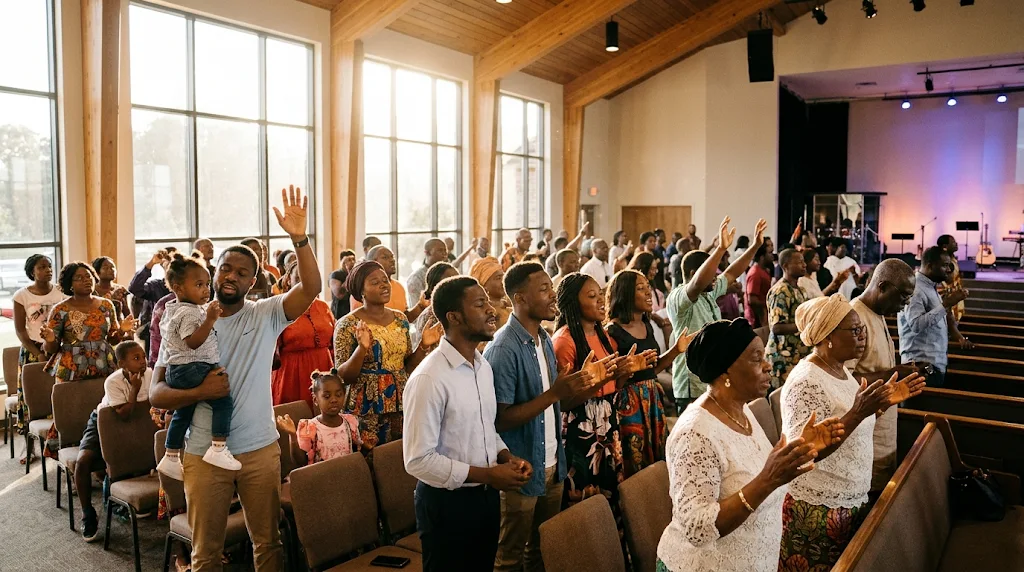
A landmark demographic study released on November 18, 2026, by the Pew Research Center has confirmed one of the most consequential geographic shifts in modern religious history: the future centre of global Christian growth is moving decisively to sub-Saharan Africa.
Spanning 201 countries and territories—representing 99.98% of the world’s population—The Future of World Religions: Population Growth Projections, 2020–2070 forecasts that while the global Christian population will grow by 30% over the next five decades to nearly 3 billion, that expansion will be driven almost entirely by African churches. By 2070, 54% of all Christians on earth are projected to live in sub-Saharan Africa, rising dramatically from 31% in 2020.
For Nigerian believers, church leaders, and diaspora ministries, the numbers carry both sobering clarity and historic responsibility. As traditional Western strongholds experience steady demographic contraction, Africa is no longer merely a recipient of global missions—it is becoming the primary engine of global Christian growth and the defining voice of 21st-century Christianity.
Pew 2026 Global Christian Growth Projections (2020–2070)
| Key Metric | 2020 Baseline | 2070 Projection | Notable Shift |
| Christians in Sub-Saharan Africa | 697 million | 1.6 billion | +896 million (more than doubles) |
| Africa’s Share of World Christians | 31% | 54% | Becomes home to over half of all Christians |
| Christians Outside Sub-Saharan Africa | — | — | Projected net decline of 210 million |
| Global Christian Share of World Population | ~29% | 29% | Holds steady at nearly 3 billion believers |
| North America Christian Share | 63% | 46% | Projected to lose Christian majority |
| Global Unaffiliated (“Nones”) Share | 24% (1.91B) | 17% (1.72B) | Declines globally despite Western increases |
The Great Geographic Shift: Why Africa Holds the Global Line
One of the most striking paradoxes in Pew’s 2026 findings is how Christianity maintains a steady 29% share of the world’s population through 2070 even as church affiliation drops steeply across Europe and North America.
The explanation behind this pattern of global Christian growth comes down to sub-Saharan Africa’s youthful energy. While European Christian populations face ageing demographics, shrinking national populations (projected to fall by 17% overall), and higher rates of people leaving the faith, sub-Saharan Africa’s Christian population is projected to surge by 896 million between 2020 and 2070—more than offsetting a projected net decline of 210 million Christians across the rest of the world combined.
That surge will also redraw the global map of the largest Christian nations. According to Pew, the Democratic Republic of the Congo (DRC) is projected to surpass the United States as the country with the largest Christian population on earth by 2070, while Nigeria, Tanzania, Uganda, and Angola climb sharply up the global rankings. Meanwhile, the United States and nine other nations are projected to lose their Christian majorities—though Christians will remain the single largest religious group in the US.
Reading the Broader Global Headlines Without Fear
Much of the international media coverage surrounding Pew’s November 18 release has focused on one headline: Islam is projected to grow by 80% to more than 3.6 billion adherents by 2070, surpassing Christianity as the world’s largest religious group as early as 2035.
Yet Pew’s researchers emphasise that this divergence—alongside the pace of global Christian growth—is primarily a story of demographics, median age, and birth rates, rather than mass religious conversion. As of 2020, the global median age of Muslims stood at 24, compared with 31 for Christians and 33 for non-Muslims overall. Even within sub-Saharan Africa—where more than a quarter of all humanity is expected to live by 2070—Muslims are projected to edge up from 33% to 36% of the regional population, while the Christian share shifts slightly from 62% to 59% despite more than doubling in raw numbers.
Equally noteworthy for Christian observers is what Pew projects for the religiously unaffiliated (often called “nones”). Although secularism continues to rise in Europe and North America, low birth rates in secularised regions mean the global unaffiliated population is actually projected to shrink from 1.91 billion (24%) in 2020 to 1.72 billion (17%) by 2070. The world of the future is not growing less religious; it is growing more devout—and far more African.
What Global Christian Growth Means for Nigerian and African Churches
Demographics alone do not guarantee spiritual depth. Pew itself cautions that statistical projections assume current fertility, migration, and religious-switching patterns continue unchanged—and cannot foresee wars, economic upheavals, or unexpected spiritual revivals.
For church leaders in Nigeria, Ghana, Kenya, South Africa, and across the diaspora, standing at the centre of global Christian growth brings four urgent responsibilities:
-
Investing in Deep Discipleship for a Youthful Continent: Numbers in pews mean very little without rooted biblical conviction. As Gen Z and Millennials return to church in search of real prayer and honest community, African churches must prioritise Scripture-grounded teaching over fleeting trends.
-
Strengthening Transparent Church Governance: When African ministries steward millions of believers and global branches, institutional accountability is no longer optional. Building clear constitutions and healthy leadership transitions—as highlighted in our recent look at what Adeboye, Kumuyi, and Oyedepo have said about church succession and why church governance must outlive founders—will determine whether this growth endures across generations.
-
Training and Sending Global Missionaries: With Christian majorities shrinking across Europe and North America, African churches and diaspora congregations are increasingly positioned to revitalise historic sanctuaries abroad through humble, culturally thoughtful witness.
-
Addressing Community Welfare and Persecution: Rapid global Christian growth in Africa unfolds alongside real economic pressure and security challenges in parts of the continent. Combining evangelism with education, healthcare, and compassionate civic advocacy ensures the Church’s influence transforms societies from the inside out.
As Pew’s 2026 report reminds the global Body of Christ, the story of Christianity has always moved across continents—from Jerusalem and Antioch to Europe, the Americas, and now powerfully into Africa. Whether global Christian growth translates into lasting spiritual renewal over the next fifty years will depend not on population charts alone, but on how faithfully today’s African Church stewards the extraordinary grace entrusted to its hands.
JOIN OUR WHATSAPP CHANNEL FOR MORE GOSPEL NEWS UPDATES AT FIRST HAND